Biddy
A Nigerian marketplace taken from zero to 10,000+ users

- Client
- Biddy
- Role
- Lead founding developer
- Year
- Nov 2023 — Jan 2026
- Status
- Live
The problem
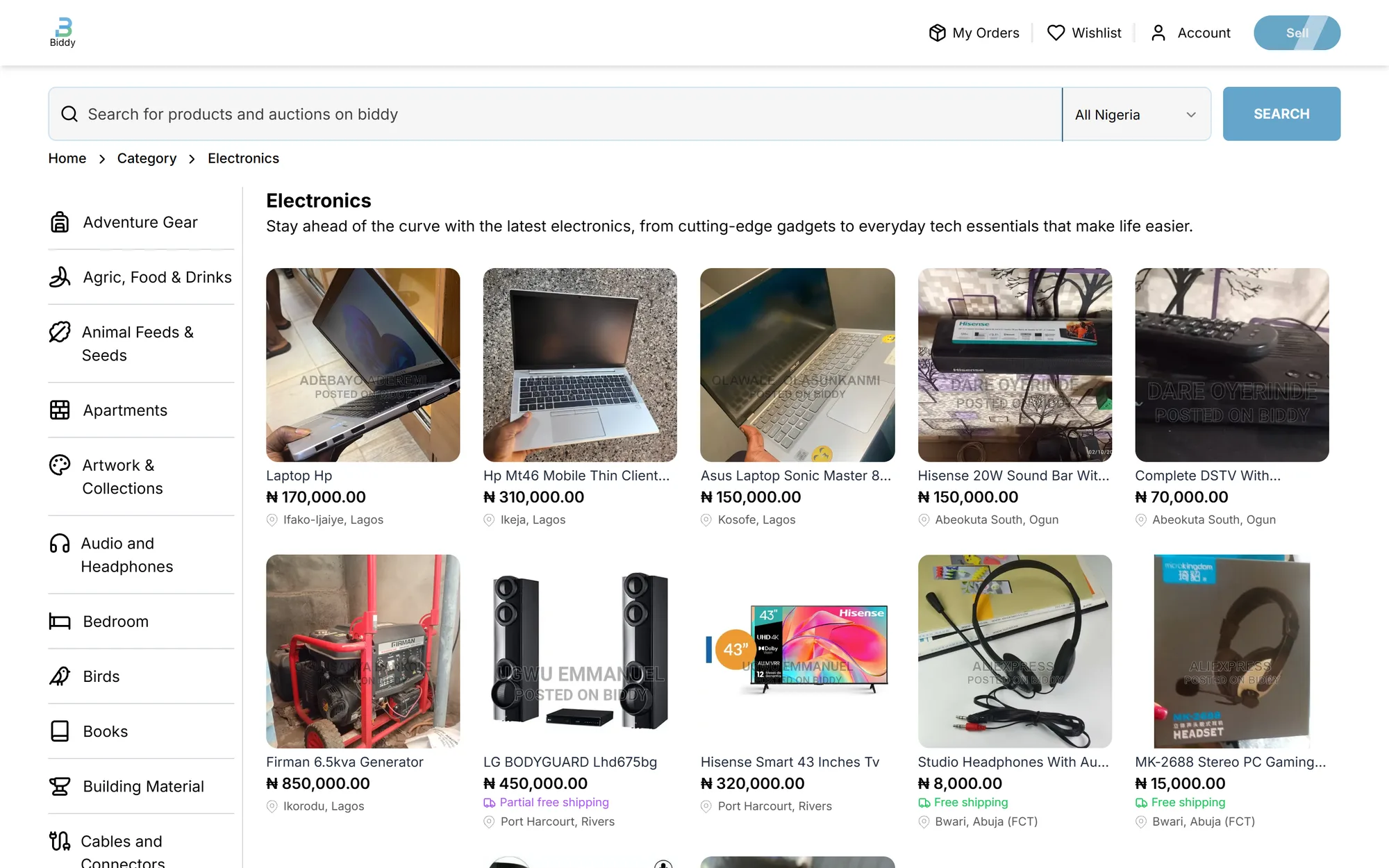
An auction-driven consumer marketplace covering electronics, fashion, vehicles, real estate and food, where sellers list, buyers check out through Paystack, and a seller tier system drives placement. Event-driven microservices behind it, and I owned architecture, frontend, backend, infrastructure and production support across roughly 1,500 commits.
Nigerian online commerce has a trust deficit at both ends: buyers can't tell a real seller from a fake listing, and sellers have no way to prove they're legitimate. Solving it needs a lot of unglamorous machinery working at once — identity, listing moderation, payments that clear locally, order tracking, returns, and a support channel — none of which is optional and none of which can be a placeholder once real money is moving.

How I built it
Payments and infrastructure chosen for where the users are
Paystack rather than Stripe, because local card and bank-transfer coverage and roughly 1.5% + ₦100 fees are what actually work for Nigerian sellers. Deployment goes GitHub Actions → a container image on GHCR → SSH deploy onto a VPS, rather than a managed platform: predictable cost in a market where margins are thin, and no per-invocation surprises during a traffic spike.
A separate console for the people doing moderation
Listing moderation is a different job from shopping, done by different people under different pressure, so it lives in a separate admin application on its own subdomain. Staff approve pending products to live, demote live products back to pending with a reason attached, manage accounts, and handle returns and orders. Signup is token-gated so only invited staff can register — the alternative is an admin panel one leaked password away from the catalogue.
Services that could fail independently
Checkout, listings, notifications and moderation don't share a failure mode, so they don't share a process. They're separate services communicating over NATS.io, which means a notification backlog doesn't stall a checkout and a moderation deploy doesn't take the catalogue down. Authentication was centralised behind Keycloak rather than reimplemented per service — one place for sessions, roles and SSO, which is also the only sane way to keep the staff console and the storefront honest about who a user is.
Owning production, not just the pull request
The part that changed how I work wasn't the architecture, it was being the person paged when the marketplace broke. Sentry for error tracking, Upstash Redis for rate limiting and caching, Pusher for realtime, a PWA layer for repeat mobile buyers. Every one of those went in because something failed first.
Built with
- Next.js
- TypeScript
- Node.js
- Python
- FastAPI
- PostgreSQL
- Prisma
- NATS.io
- Keycloak
- Paystack
- AWS S3 + SES
- Upstash Redis
- Sentry
- Docker
- Kubernetes
- GitHub Actions
Outcome
- Grew past 10,000 users with millions of naira in transactions processed
- ~1,500 commits across the marketplace and a separate token-gated admin console
- Event-driven services over NATS.io with Keycloak SSO across the platform
- Paystack checkout, order tracking, returns, reviews and live chat in production
- Containerised CI/CD from GitHub Actions through GHCR to a self-managed VPS